
Breeds · breed profile
The Ardennes horse
Trait Ardennais
The Ardennes is a compact draught horse with a deep chest and powerful hindquarters. French breeding is strongly associated with the northeast, within a wider breed tradition that crosses national borders. The French programme aims to preserve this build, develop working ability and monitor lower-limb health.
- Category
- Horse
- Country of origin
- France
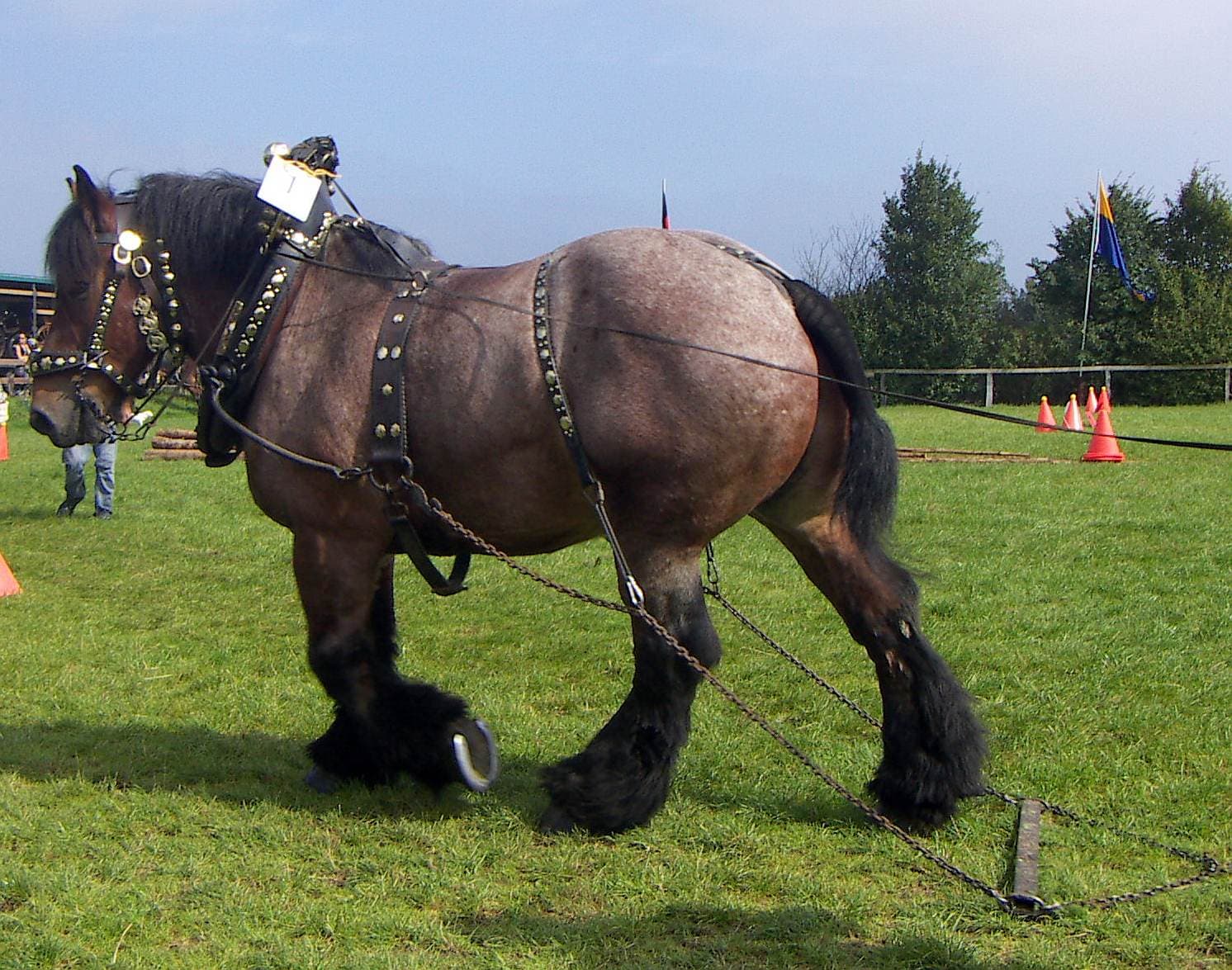
An Ardennes horse equipped for forestry work, photographed in 2007.

The Ardennes horse, from farming to present-day uses
The Ardennes horse: Northeastern France and neighbouring regions
The French home region includes the Ardennes, Lorraine and Alsace, now within Grand Est. Breeding is connected with neighbouring countries. Transport, farming and pulling heavy loads favoured compact, muscular horses over successive generations.
The Ardennes horse: a studbook founded in 1908
The Société hippique des Ardennes established the studbook at Mézières in 1908. It records horses and their parents so families can be followed over time. French breeders and identification services subsequently developed the organisation, with agreements governing relationships with other Ardennes studbooks.
The Ardennes horse: Mechanisation changed breeding demand
The decline of animal traction reduced agricultural demand. Meat production became an important market, while breeders also developed driving, leisure activities and new working uses. The current programme combines breed conservation with training young horses for these activities.
Sources for this section: UECRA [1]
The Ardennes horse: the French Ardennes standard
The Ardennes horse: a compact body and strong limbs
Union des éleveurs de chevaux de la race ardennaise (UECRA) describes the desired traits of the Ardennes in its breeding programme. This document guides the choice of breeding animals. UECRA seeks a broad, deep chest, fairly short back, muscular loins and powerful croup. The head has a broad forehead and the well-attached neck is generally arched. Joints should be broad, feet sound and movement free and supple despite the horse's mass.
The Ardennes horse: Separate height ranges for males and females
The Ardennes breed standard specifies 1.54–1.66 m for stallions and 1.52–1.64 m for mares. A 3 cm allowance may be accepted subject to conformity requirements and a conformation score of at least 78. These are French programme rules, not measured averages for every Ardennes population.
Sources for this section: UECRA [1]
The Ardennes horse: Colours accepted in the French Ardennes
The Ardennes horse: Bay, roan, chestnut and other standard colours
The Ardennes breeding programme favours bay, roan, chestnut, iron grey and chestnut roan, traditionally called aubère in French. Black and noir pangaré, a dark coat with lighter areas, are tolerated. These are the standard's appearance categories, not measured frequencies of genetic variants.
The Ardennes horse: White hairs mixed with coloured hairs
Roan combines white and pigmented hairs over much of the body, with the head and lower legs generally darker. Chestnut roan has this mixture over a chestnut base. It differs from progressive greying, which can make the coat much lighter as the horse ages.
Sources for this section: UECRA [1] · UC Davis [3]
Working roles and markets for the Ardennes horse
The Ardennes horse: Farm, forestry and community work
Ardennes horses can be trained to pull farm equipment, move timber or carry out transport work. Horse logging involves moving felled timber to a collection point. Local services may also use horses for site maintenance or passenger transport, depending on training and equipment.
The Ardennes horse: Driving, leisure and meat production
Driving and handling courses showcase a horse's response to the driver's cues. The programme encourages gradual training of young horses to support these markets. Meat production remains part of the sector, so working uses alone do not represent all Ardennes breeding.
Sources for this section: UECRA [1]
The Ardennes horse: Entering the French Ardennes studbook
The Ardennes horse: UECRA's role
The Union des éleveurs de chevaux de la race ardennaise, or UECRA, runs the selection programme. The French studbook provides for registration by descent, certain initial admissions and imports. Foals need eligible breeding parents, birth notification and identification under the prescribed procedures.
The Ardennes horse: DNA typing of dams and checks for stallions
Since 2004, dams must be DNA typed before their first foal is registered. Stallion candidates need confirmed parentage, established by comparing their DNA with that of the recorded parents. Verification is also required for foals from insemination or embryo transfer under the rules.
The Ardennes horse: Outside contributions require assessment
Certain horses from other draught studbooks may be accepted as breeding contributors to the French Ardennes. This requires examination, a minimum score and compatible parentage. The route allows selected outside contributions; it does not automatically admit every draught horse.
Sources for this section: UECRA [1]
The Ardennes horse: Ardennes distribution and breeding activity
The Ardennes horse: Grand Est and other French regions
Grand Est remains the main home region of the French programme, with breeding also established in central and southwestern France. Other countries maintain their own Ardennes studbooks. Figures from one national programme therefore do not represent a worldwide census.
The Ardennes horse: 547 French births recorded in 2022
The Ardennes breeding programme records 547 births, 1,100 mares covered and 177 active stallions in France in 2022. These are three different categories. Adding them would not give a living population total, because older horses outside breeding are not counted by these activity measures.
Sources for this section: UECRA [1]
The Ardennes horse: Parentage, family diversity and limb health
The Ardennes horse: Following families when planning matings
Pedigrees and parentage checks help identify shared ancestors. Retaining several families involves avoiding excessive reliance on a few related breeding animals. DNA typing secures the genetic identity used in these records, while observation of limbs and movement remains necessary.
The Ardennes horse: Lymphoedema is assessed on the horse
Chronic progressive lymphoedema causes lasting swelling of the lower legs, with thickened skin and folds. UECRA grades these signs and restricts severely affected horses. Veterinary research suggests a genetic contribution, but there is no single validated DNA test that can certify an Ardennes horse free of the condition; clinical assessment remains essential.
Sources for this section: UECRA [1] · UC Davis, 2019 [2]
Sources and review date
Profile reviewed on .
The UECRA programme was revised on 20 April 2025. The breeding figures relate to 2022. The veterinary source explains lymphoedema without providing a frequency estimate for the French Ardennes population.
- French Ardennes selection programme, version dated 20 April 2025
History, standard, French regulations, 2022 breeding activity and lymphoedema assessment.
- Chronic Progressive Lymphedema, Amy Young and Verena Affolter
Veterinary description and uncertainty about genetic causes.
- Veterinary Genetics Laboratory — Roan
The mixture of white and pigmented hairs, distinct from progressive greying.