
Breeds · breed profile
The Arabian
Arabian · Purebred Arabian
The Arabian is a riding horse with its homeland in the Middle East. Its breeding developed around the travel and military needs of desert communities, before spreading to studs in many countries. Today the breed is found in endurance, Flat racing and in-hand showing. Registration depends on a recognised studbook, rather than appearance alone.
- Category
- Horse
- Country or region of origin
- Middle East
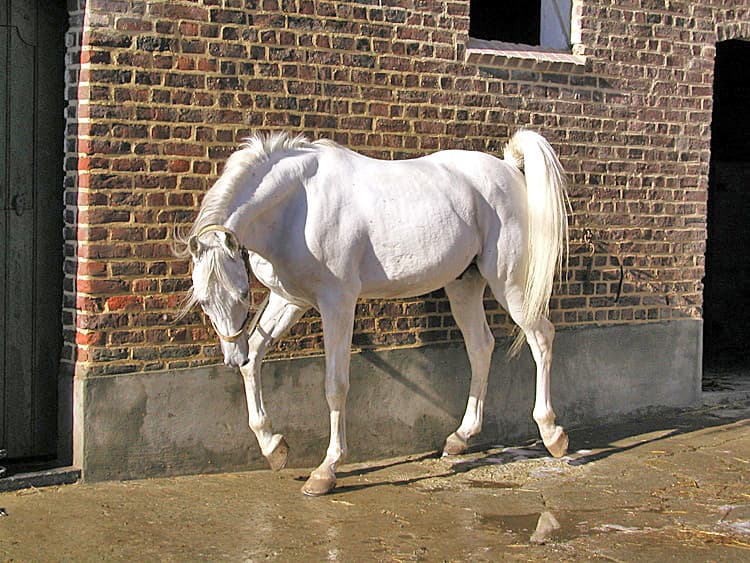
The grey Arabian stallion Vashara Chamal, photographed in 2006.

The Arabian: From the Middle East to international breeding
The Arabian: Horses and the communities of the desert
Arabian history is rooted in the Arabian Peninsula and neighbouring parts of the Middle East, particularly Bedouin communities. Horses provided transport, a military resource and wealth passed between families. Breeding favoured stamina and the ability to live in hot, dry conditions. Horse families and breeding traditions predate modern registers: they should not be treated as a breed already registered under today's rules.
The Arabian: Crabbet and imports to England
In 1878, Lady Anne Blunt and Wilfrid Blunt began breeding Arabians at Crabbet Park in England. They acquired horses in the Middle East and later from Egyptian breeding programmes. Their daughter, Lady Wentworth, continued the work and introduced the stallion Skowronek. Sales and exports carried these families into other studs. “Crabbet” therefore identifies a breeding history and ancestry within the Arabian breed.
The Arabian: Janów Podlaski through war and rebuilding
The Polish stud of Janów Podlaski was established in 1817 with several types of horse. Following losses in the First World War, its Arabian breeding programme was rebuilt from 1919. The Second World War brought further displacement and losses; the programme’s Arabians returned to Janów in 1960–1961. The founding of a stud, the start of its Arabian programme and the return of its horses can therefore refer to different dates.
The Arabian: From historical type to registered breed
In 1974, the World Arabian Horse Organization, or WAHO, adopted a shared definition based on entry in a studbook it recognises. Recognition allows national organisations to accept the pedigrees of horses moving between countries. Labels such as “Egyptian”, “Polish” and “Crabbet” describe ancestry or breeding programmes. Anglo-Arabians and part-bred Arabians follow separate crossbreeding and registration rules.
Sources for this section: Cosgrove et al., 2020 [8] · AHA · Crabbet [3] · Janów · stud history [4] · Janów · Arabian breeding [5] · WAHO · breed identity [1]
The Arabian: Conformation and height in context
The Arabian: an expressive head without exaggeration
The judging guide published by the Arab Horse Society of South Africa describes a relatively short head, large, widely spaced eyes, open nostrils and a straight or slightly concave profile. The neck is arched and well set on. The aim is a balanced whole; an extremely dished profile is not a requirement for breed membership. Characteristics assessed in an in-hand class belong to that judging framework.
The Arabian: a compact body and free movement
The Arab Horse Society of South Africa’s judging guide seeks a short, strong back, a deep chest, well-developed ribs and a fairly level croup with a high tail carriage in the Arabian. Limbs should be correctly aligned, with clean joints and proportionate feet. In motion, judges look for suppleness, balance and impulsion. Energy and willingness to work are also described qualities, connected to the horse's ridden use.
The Arabian: a descriptive range, not a worldwide entry limit
The South African guide gives 14.1 to 15.1 hands, approximately 1.45 to 1.55 m at the withers, while acknowledging smaller and taller individuals. The notation combines four-inch hands with additional inches: 14.1 means 14 hands and one inch. This range describes the type being judged; the French rules for 2026 do not turn it into a minimum or maximum registration height.
The Arabian: Showing, performance and registration
In-hand classes compare breed type, conformation and movement. Endurance and racing breeders also select for performance in their discipline. These assessments serve a different purpose from the studbook, which records identity and parentage. A show placing is therefore not a universal condition for registering an Arabian foal.
Sources for this section: AHSSA · judging guide [2] · ACA / IFCE · 2026 rules [6]
The Arabian: Coat colours and progressive greying
The Arabian: Colours documented in the breed
The judging guide describes bay, chestnut, grey and black, with white markings possible. These colours form part of the Arabian's description; the list does not establish their frequency in today's breeding population. An unusual colour or a strongly characteristic head cannot, by itself, establish a horse's registered ancestry.
A grey Arabian may be born dark
Progressive greying adds white hairs to a coloured birth coat. An Arabian born bay may become almost white with age while retaining pigmented skin. This process, associated with STX17, differs from a white coat present at birth. A photograph of an adult grey does not always reveal its underlying coat colour.
Sources for this section: AHSSA · judging guide [2] · UC Davis · grey [14]
The Arabian: From transport to modern disciplines
The Arabian: Travel and military uses
In Bedouin societies, horses served rapid travel and military expeditions. These uses helped favour stamina, mobility and cooperation with the rider. Imports to foreign studs subsequently served several purposes: maintaining Arabian families, producing riding horses and using breeding stock in other horse populations.
The Arabian: an important role in endurance
Arabians have an important place in endurance racing. Horse and rider cover a route divided into loops, with rest periods and veterinary inspections between them. Veterinarians assess recovery and soundness before allowing the horse to continue. Success requires sustaining effort over a distance while remaining fit to proceed; speed alone is insufficient for a classified finish.
The Arabian: Racing, showing and riding
Some Arabians are bred for Flat races restricted to the breed. Other programmes focus on in-hand showing, where conformation and movement are assessed. Leisure riding and ridden competition provide further uses. These breeding directions help explain differences in build between families, without each direction having a separate worldwide studbook.
Sources for this section: Cosgrove et al., 2020 [8] · FEI · endurance [9] · AHSSA · judging guide [2]
The Arabian: Studbooks and breeding rules
The Arabian: WAHO and national registering authorities
WAHO coordinates studbook recognition and common registration rules. The relevant organisations in individual countries maintain registers, process foal registrations and handle imports and exports. A studbook links each horse to its parents and preserves that relationship across generations. The system works through recognition between registers; WAHO does not maintain a single worldwide register of every birth.
The Arabian: the ACA and IFCE in France
The French Arabian studbook rules effective on 1 January 2026 set out the work of the Association française du cheval Arabe, or ACA, and IFCE, which handles SIRE procedures. Foal registration requires, among other things, a declared covering, identification and compatible parentage verification. A laboratory compares DNA markers from the foal with those of its declared parents to check the relationship. This makes the recorded pedigree more reliable.
The Arabian: Permitted methods under national conditions
The French 2026 rules permit natural service, artificial insemination and embryo transfer for Arabians. Embryo transfer allows a recipient mare to carry an embryo conceived by another mare. Under the stated procedure, the rules allow only one registrable embryo-transfer offspring per donor mare and birth year. Fertilisation must take place inside the mare: this excludes laboratory fertilisation, including ICSI.
Sources for this section: WAHO · breed identity [1] · ACA / IFCE · 2026 rules [6]
The Arabian: Distribution and documented foal registrations
The Arabian: Breeding across several continents
Arabians are bred in the Middle East, Europe, the Americas, Africa and Oceania. Recognised studbooks and exchanges between them allow pedigrees to be followed across borders. The existence of a national registering organisation shows how breeding is organised; it does not itself establish how many horses are currently alive in that territory.
The Arabian: French foal registrations for 2024
IFCE's ÉCUS 2025 yearbook records 1,408 registered Arabian births in France for 2024, using SIRE data as at 21 October 2025. The figure is provisional because some files were not yet complete. It covers one registered foal crop, rather than all living Arabians in France. A studbook's historical total instead combines generations, including horses that have died; these counts answer different questions.
Sources for this section: WAHO · breed identity [1] · IFCE · ÉCUS 2025 [7]
The Arabian: Genetic diversity and tests for breeding decisions
The Arabian: What an international study shows
In 2020, Cosgrove and colleagues studied DNA from 378 Arabians originating in 12 countries. They compared many markers and, for some horses, genome sequences. Results showed substantial diversity and differences between ancestry groups; the Egyptian group studied was more genetically uniform. The sample helps explain family structure. It does not measure today's disease frequency in all Arabians, and a named lineage does not capture every relationship between two breeding animals.
The Arabian: SCID: identifying unaffected carriers
Severe combined immunodeficiency, or SCID, prevents normal development of a foal's immune defences and is fatal. The test looks for the known PRKDC variant to identify carriers that are unaffected but can pass it on. The result helps breeders avoid a mating that could bring two copies of that variant together in a foal.
The Arabian: Cerebellar abiotrophy: another targeted test
Cerebellar abiotrophy, abbreviated CA, affects cells in the cerebellum, the part of the brain involved in coordination. It can cause head tremors and loss of balance. The associated DNA test identifies carriers and informs mating decisions. Compatible parentage does not establish CA status: the two analyses look for different information.
The Arabian: Lavender foal syndrome and OAAM
Lavender foal syndrome, or LFS, combines a markedly diluted coat with severe neurological problems; its test looks for a MYO5A variant. It is more than a light coat colour. Another test concerns one form of malformation at the junction of the skull and first neck vertebrae, called OAAM1. A negative result excludes the tested variant, rather than every possible cause of malformation in that region.
The Arabian: Understanding the risk for each foal
For these recessive conditions, a carrier has one copy of the variant and may appear healthy. When both parents carry the same disease-associated variant, an affected foal has a 25% probability at each conception. That is a one-in-four chance for each foal, rather than a requirement that every four births include one affected foal. Testing both parents supports mating choices while retaining families that contribute to diversity.
The Arabian: What the French rules actually require
Since the 2017 covering season, stallions producing for the French studbook must undergo SCID and CA testing, with results published; the 2026 rules retain this requirement. Testing is required, without a carrier result automatically excluding all breeding. LFS and OAAM1 tests address further breeding questions: inclusion in a laboratory panel does not make them compulsory in every country.
Sources for this section: Cosgrove et al., 2020 [8] · UC Davis · SCID [10] · UC Davis · CA [11] · UC Davis · LFS [12] · UC Davis · OAAM [13] · ACA / IFCE · 2026 rules [6]
Sources and update
Profile updated on .
Breed organisations explain the requirements for registering Arabian horses. The scientific papers investigate genetic diversity and particular DNA tests. The results identify the countries, dates and groups of horses covered by each study.
- WAHO — Requirements for establishing and keeping a stud book, 2019 edition (VZAP)
Definition adopted in 1974 and recognition between studbooks; WAHO document hosted by German registering authority VZAP. French requirements are checked against the 2026 rules.
- Arab Horse Society of South Africa — A Guide for Judging the Arabian Horse
Conformation, colours and 14.1–15.1 hand range, with individuals outside it; judging guidance rather than French registration rules.
- Arabian Horse Association — Crabbet Arabians
The Blunts' programme from 1878, Lady Wentworth and the spread of these bloodlines.
- Janów Podlaski — History of the stud
The stud’s foundation in 1817, reorganisation after the First World War and displacement during the Second World War.
- Janów Podlaski — History of Arabian breeding
Programme rebuilt from 1919, post-war dispersal and return of the Arabians to Janów in 1960–1961.
- French Arabian stud book regulations, effective 1 January 2026
Registration, parentage, stallion SCID and CA testing and reproductive methods; Articles 2, 4 and 6.
- IFCE — ÉCUS 2025 yearbook, page 22
1,408 registered Arabian births in France for 2024; provisional SIRE data as at 21 October 2025.
- Cosgrove et al. (2020) — Genome Diversity and the Origin of the Arabian Horse
Scientific Reports, 10, 9702. Study of 378 Arabians from 12 countries, compared with other populations.
- FEI — From 0 to 160km: Training Horses for Endurance
Loops, rest periods and veterinary inspections during competition.
- UC Davis VGL — Severe Combined Immunodeficiency
Disease, PRKDC variant, unaffected carriers and recessive inheritance.
- UC Davis VGL — Cerebellar Abiotrophy
Neurological signs, purpose of testing and interpretation of results.
- UC Davis VGL — Lavender Foal Syndrome
Fatal neurological condition, associated coat dilution and the MYO5A variant test.
- UC Davis VGL — Occipitoatlantoaxial Malformation
Testing for one form of the malformation, limited to the variant examined.
- UC Davis VGL — Gray copy number
Progressive greying and STX17, distinct from white present at birth.