
Breeds · breed profile
The Appaloosa
Appaloosa · Appaloosa Horse Club (ApHC)
The Appaloosa is an American breed with a history connected to horses raised by the Nez Perce, or Nimiipuu, in the northwestern United States. The Appaloosa Horse Club has organised its modern registry since 1938. A spotted horse is not necessarily an Appaloosa: other breeds can have similar coats. Registration as an Appaloosa also depends on the horse’s parentage and the registry’s entry requirements.
- Category
- Horse
- Country of origin
- United States
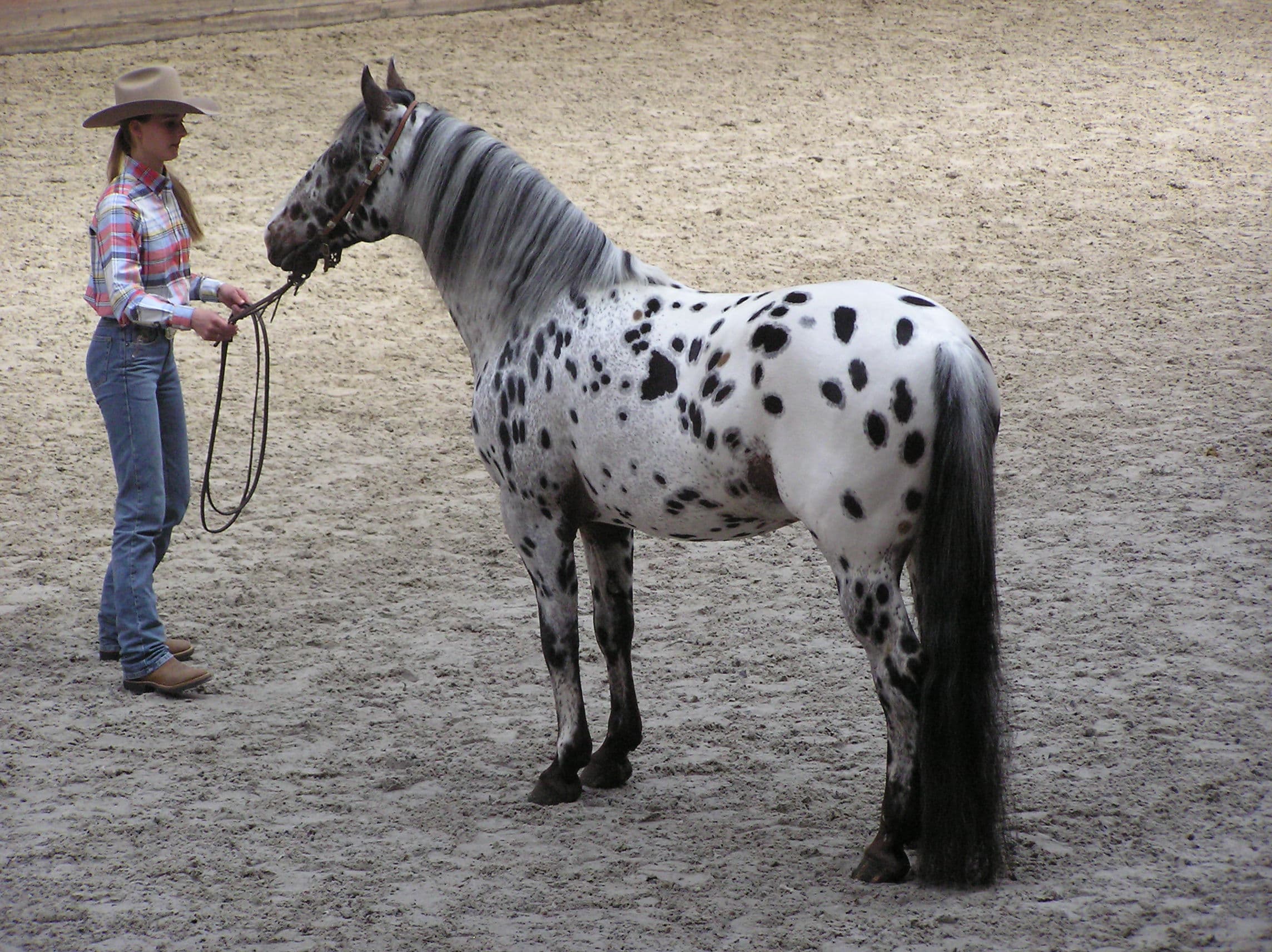
An Appaloosa stallion shown at Císařský ostrov, Prague, on 14 April 2007.

The Nez Perce and the registered Appaloosa’s development
The Appaloosa: Horses in Nimiipuu life
In the American Northwest, the Nez Perce raised horses for travel, carrying goods, hunting, trade and racing. Their herds included both spotted and solid-coloured horses. The name Appaloosa is associated with the expression ‘a Palouse horse’, referring to the Palouse River region. These horses belong to a human and territorial history; spotting patterns, found elsewhere in the world, did not originate with the modern registry.
The Appaloosa: the 1877 war scattered the herds
Pressure on Nez Perce lands and forced relocation led to the war of 1877. Families and their horses travelled a long route across several territories while pursued by the US Army. Fighting, seizure and dispersal of the horses severely disrupted breeding. Surviving animals and their descendants were subsequently retained in different herds, including ranch herds in the Northwest.
The Appaloosa: a modern registry founded in 1938
The Appaloosa Horse Club was founded in 1938 to collect historical records, register horses and develop the breed. Modern selection uses Appaloosa families and the outcrosses permitted by the registry. It produces horses for uses ranging from ranch work to competition. Today’s registered Appaloosa reflects this organisation and is distinct from the full historical population of Nez Perce horses.
The Appaloosa: an equestrian culture still being passed on
The Chief Joseph Foundation, an organisation connected with the Nez Perce community, passes on equestrian culture and skills through activities involving Appaloosas. It connects riding and horse care with remembrance, community relationships and young people’s learning. This living heritage has a different scope from the administrative categories of a breed registry or sporting programme.
Sources for this section: ApHC · 2026 handbook [1] · NPS · 1877 [2] · Chief Joseph Foundation [3]
Appaloosa conformation and height
The Appaloosa: Balance and muscular hindquarters
The ApHC 2026 standard seeks a lean, straight-profiled head, medium ears, a well-set neck and a clean throatlatch. The chest is deep, the shoulders sloping and muscular, and the withers defined. The back and loin are short, and the croup long and muscular. The overall body should be balanced and smoothly joined, with musculature suited to movement.
The Appaloosa: Limb alignment and movement assessed at shows
The Appaloosa breed standard details limb alignment from the front, side and rear, together with rounded feet that are open at the heels. In conformation classes, judges assess structure, movement and soundness. The amount of spotting does not replace these criteria. Sporting priorities then depend on the discipline: a race and a precision obstacle course assess different qualities.
The Appaloosa: a descriptive range rather than a universal rule
The American Museum of Natural History gives a typical height of 14–16 hands, approximately 142–163 cm at the withers. This is a general description rather than a single ApHC registration condition. The handbook includes a particular hardship route for certain geldings and spayed mares, with its own minimum of 14 hands from five years of age. A threshold for that procedure should not be applied to the whole breed.
Sources for this section: ApHC · 2026 handbook [1] · AMNH · descriptive height [4]
Appaloosa patterns, LP and PATN1
The Appaloosa: Varied patterns that may change with age
The Appaloosa breed standard describes many base colours and patterns: pigmented spots across a largely white background, white over the hindquarters with or without spots, or progressive intermingling of white and coloured hair. Registered horses may also look solid-coloured. Patterns can change throughout life, so a photograph records an appearance at one moment without establishing genotype or registration category.
The Appaloosa: Other visible leopard-complex traits
Leopard complex, associated with LP, can also involve mottled skin around the muzzle and eyes, readily visible white sclera and striped hooves. The rules explain how these features are recognised, including situations where white leg or face markings could imitate them. These observations describe the horse and help determine registration, alongside the other registry requirements.
The Appaloosa: PATN1 increases white patterning when LP is present
PATN1 is a modifier that generally increases the extent of white when LP is present. Holl and colleagues studied its inheritance in families and then genotyped an initial group of 192 horses from five LP-carrying breeds. Their work, published online in 2015 and in the 2016 volume, identified an associated RFWD3 variant. Testing helps explain possible patterns; PATN1 alone does not create leopard complex or predict the exact position of every foal’s spots.
Sources for this section: ApHC · 2026 handbook [1] · UC Davis · LP / CSNB [8] · Holl et al. · PATN1 [9] · UC Davis · PATN1 [10]
Appaloosas at work and in equestrian sport
The Appaloosa: From travel and hunting to ranch work
Historical uses combined travel, hunting, transport and racing within northwestern communities. Horses retained on ranches later contributed to cattle work and rural activities. This background helps explain the importance of present-day disciplines in which the horse accelerates, turns and responds promptly to the rider.
The Appaloosa: Western and English events
ApHC programmes include western events, cattle classes, racing and English riding classes. In trail, a horse may negotiate poles and narrow passages or position itself for opening a gate; ranch classes use movements related to working tasks. Appaloosas are also used for hacking and trekking. These programmes distinguish sporting results from pedigree registration.
Sources for this section: ApHC · 2026 handbook [1] · Chief Joseph Foundation [3]
The Appaloosa: ApHC registration requirements and French identification
The Appaloosa: an eligible pedigree
Under the ordinary route in the 2026 handbook, one parent must have ApHC Regular (#) registration. The other may belong to eligible Appaloosa categories, the Appaloosa Horse Club of Canada or approved Quarter Horse, purebred Arabian and Thoroughbred registries. Parents of those other breeds must meet ApHC listing requirements. A crossbred horse’s spotted colour alone therefore does not make it eligible.
The Appaloosa: Regular and Non-Characteristic are separate categories
Regular (#) registration combines an eligible pedigree with the required characteristics: a recognised pattern, or mottled skin with another specified trait, with provisions for LP testing. A horse with eligible ancestry but without the required characteristics may be registered Non-Characteristic (N). The handbook allows advancement to Regular under stated conditions, including LP testing on a parentage-verified sample. An N parent must be bred to a Regular Appaloosa for its foal to be eligible for registration.
The Appaloosa: Specific routes have their own conditions
Hardship registration covers certain geldings and spayed mares without eligible pedigrees; it is not a general route for admitting spotted breeding stock. The handbook also provides a route for a horse already registered with an approved breed, carrying LP and displaying the required pattern, with parentage verification and additional conditions. DNA parentage compares the horse with its declared parents. It is required in several situations, including online registration and specified reproductive techniques.
The Appaloosa: an ApHC certificate and SIRE identification
Breed registration is handled by ApHC, while the Appaloosa Horse Club France supports the breed in France. IFCE’s ‘Races et appellations’ guidance, updated on 18 November 2025, places the Appaloosa among breeds with a simplified procedure. IFCE can issue the identification document using the foreign certificate of origin. This French identity and traceability procedure does not create another colour standard or replace ApHC eligibility requirements.
Sources for this section: ApHC · 2026 handbook [1] · IFCE · identification [5]
Appaloosa distribution and breeding figures
The Appaloosa: Breeding beyond the United States
ApHC accepts applications for horses bred outside the United States when they meet its requirements. Affiliated associations and competitions support the breed’s spread, including in Europe. Historical registration totals accumulate multiple generations, including deceased horses, and cannot establish how many Appaloosas are alive worldwide today.
The Appaloosa: 29 active stallions in SIRE-recorded production for 2024
IFCE’s ÉCUS 2025 yearbook lists 29 active Appaloosa stallions for 2024 in production recorded by SIRE. An active stallion has covered at least one mare during the year. These figures were provisional on 21 October 2025; foreign coverings and free-running matings may only become known when the offspring is registered. This is neither a count of all Appaloosas in France nor a count restricted to stallions physically present there.
Sources for this section: ApHC · 2026 handbook [1] · IFCE · 2024 stallions [6]
LP, night blindness, uveitis and Appaloosa genetic tests
The Appaloosa: Two LP copies and congenital night blindness
In 2013, Bellone and colleagues identified a TRPM1 insertion associated with leopard complex and congenital stationary night blindness, or CSNB. The study tested the coat-pattern association in 511 horses and the CSNB association in 43. In horses with two copies, written LP/LP, signalling involved in low-light vision is disrupted. The condition is present from birth and differs from progressive loss of vision caused by inflammation.
The Appaloosa: Uveitis is a separate risk from CSNB
Equine recurrent uveitis is inflammation inside the eye that can progressively damage vision. LP/LP horses are at increased risk, but an LP result does not diagnose inflammation. Kingsley and colleagues published a 2025 study of 96 Appaloosas, expanded to 157 horses including 70 cases and 87 controls. A region on chromosome X was associated with risk; independent confirmation is needed before developing a new clinical test. Recruiting affected and control horses does not measure disease prevalence across the breed.
The Appaloosa: LP testing supports mating and management decisions
The LP test counts copies of the variant to identify what a horse can transmit and recognise homozygotes affected by CSNB. Two N/LP parents have a one-in-four chance of producing LP/LP at each conception. Here, N means the version without the tested LP insertion, rather than absence of the TRPM1 gene. A veterinary eye examination separately assesses clinical health, including signs of uveitis; PATN1 testing addresses the extent of white patterning.
The Appaloosa: HYPP testing also depends on ancestry
The HYPP test detects an SCN4A variant that can cause episodes of muscle weakness or contractions, even with one copy. It is known in descendants of the Quarter Horse Impressive. The ApHC 2026 handbook requires testing and recording of results in specified HYPP ancestry situations, including descendants of positive horses. A commercial panel combining several diseases does not make all those tests compulsory for every Appaloosa.
Sources for this section: Bellone et al. · 2013 [7] · UC Davis · LP / CSNB [8] · Kingsley et al. · 2025 [11] · ApHC · 2026 handbook [1] · UC Davis · HYPP [12]
Sources and updates
Profile updated on .
The ApHC 2026 handbook sets out registration categories and requirements. Historical and cultural sources explain the Nez Perce connection; scientific papers distinguish appearance, congenital night blindness and uveitis risk.
- Appaloosa Horse Club — Official Handbook 2026
Standard p. 5; pedigree, categories and exceptions pp. 53–57; DNA parentage pp. 61–62 and HYPP provisions. Version linked from the official handbook page.
- Nez Perce National Historical Park — The Flight of 1877
Chronology and context of forced relocation and the Nez Perce flight pursued by the US Army.
- Chief Joseph Foundation — Nez Perce equestrian heritage
The present role of Appaloosa activities in culture, learning and community relationships.
- American Museum of Natural History — Appaloosa
A descriptive 14–16 hand range, rather than an ApHC registration rule.
- IFCE — Races et appellations, updated 18 November 2025
Appaloosa as a simplified-procedure breed: IFCE identification based on a foreign certificate of origin.
- IFCE — ÉCUS 2025 yearbook, page 12
29 active Appaloosa stallions for 2024; definition and coverage note for SIRE data provisional on 21 October 2025.
- Bellone et al. (2013) — TRPM1 insertion, leopard complex and CSNB
PLoS ONE, 8:e78280. Pattern association in 511 horses and night-blindness association in 43, rather than breed disease prevalence.
- UC Davis VGL — Leopard complex, CSNB and uveitis
LP testing, copy number, low-light vision and uveitis risk, with their distinct interpretations.
- Holl et al. (2016) — RFWD3 and the PATN1 modifier
Animal Genetics, 47:91–101, online 16 November 2015. Families, an initial 192 horses from five breeds and additional validation groups.
- UC Davis VGL — Appaloosa Pattern-1
White-pattern extent in the presence of LP, without exact prediction of individual spots.
- Kingsley et al. (2025) — Genetics of insidious uveitis in Appaloosas
BMC Genomics, 26:904. Initial 96, expanded to 157 horses including 70 cases and 87 controls; chromosome X association requiring confirmation.
- UC Davis VGL — Hyperkalemic periodic paralysis
SCN4A variant, dominant inheritance and Impressive ancestry. Registration requirements are defined separately by ApHC.