
Breeds · breed profile
The Anglo-Arabian
Anglo-Arabe · AA
The Anglo-Arabian developed in southwestern France from Arabian and Thoroughbred horses, with contributions from local mares. Breeders maintain both racing and sport bloodlines, particularly for eventing. Permitted ancestry and the pedigree percentage of Arabian blood determine a horse's place in the French studbook.
- Category
- Horse
- Country of origin
- France
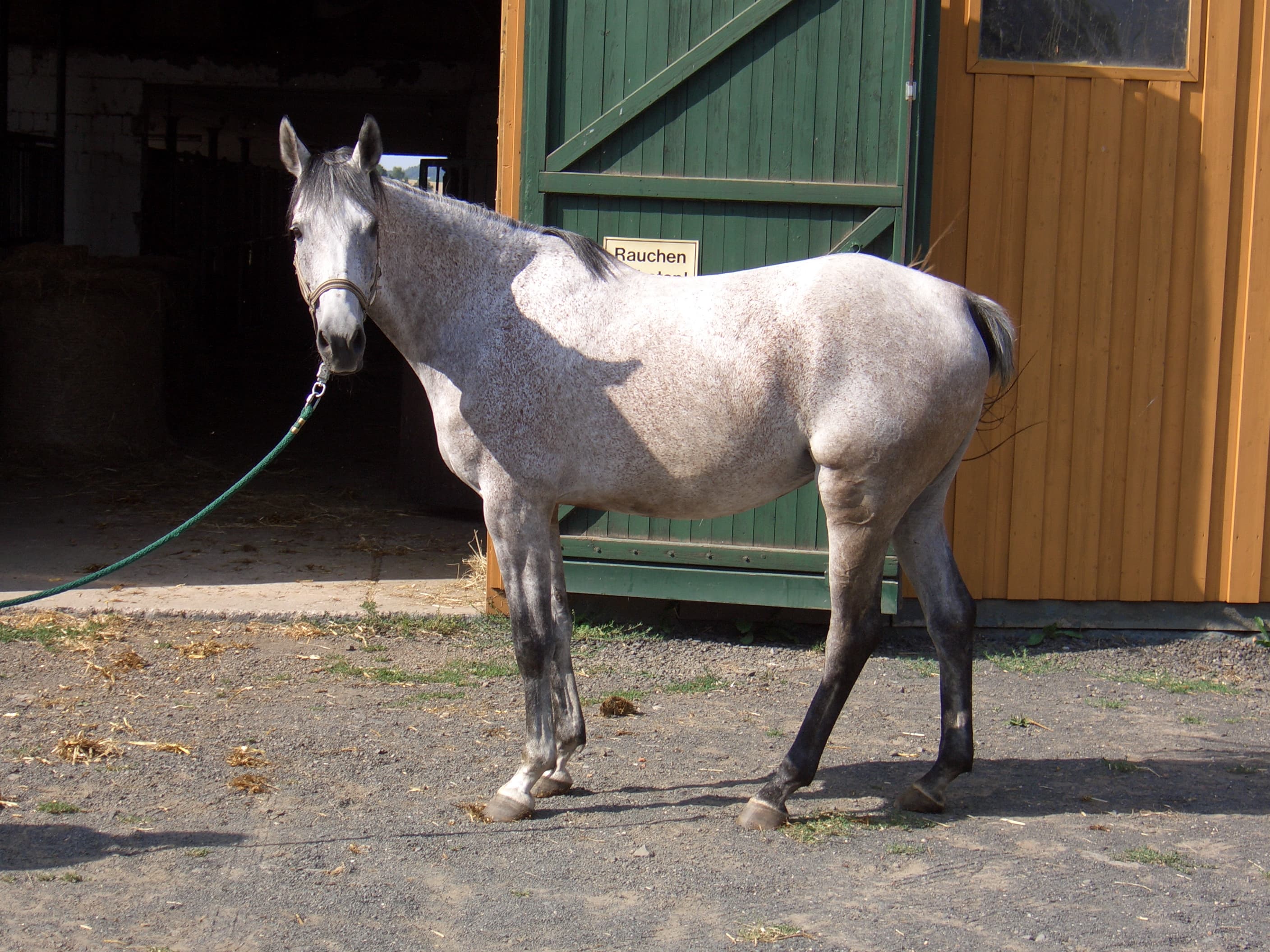
An Anglo-Arabian mare photographed outside a stable in July 2006.

The Anglo-Arabian's French origins
The Anglo-Arabian: Founding crosses in the southwest
Limousin and the establishments at Tarbes and Pau contributed to crosses between Arabians and Thoroughbreds, with local mares also playing a part. ANAA dates the studbook's beginnings to 1833. Subsequent generations of selection developed families beyond the original cross.
The Anglo-Arabian: Racing and sport bloodlines
Racing sustained selection for speed and the ability to maintain effort. Equestrian sport introduced other assessments, including jumping and performance over varied terrain. Both directions remain within the same studbook, with their own competition programmes.
The Anglo-Arabian: Coordination between national studbooks
The 1993 Venice agreements established an international definition of the Anglo-Arabian. The French studbook has since developed its sections and permitted crosses. Current applications are governed by the articles now in force, rather than an older definition reduced to one ancestry percentage.
Sources for this section: ANAA [1]
The Anglo-Arabian's desired conformation
The Anglo-Arabian: Balance and freedom of movement
Association nationale de l’Anglo-Arabe (ANAA) describes the desired traits of the Anglo-Arabian in its breeding programme. This document guides the choice of breeding animals. ANAA seeks an expressive head, broad forehead, sufficiently long neck and sloping shoulder. The back and loins should be strong, the chest deep, and the croup and hip well developed. Sound feet and correctly aligned limbs support broad, supple and balanced movement.
The Anglo-Arabian: Height is no longer an exclusion criterion
The 2025 programme explains that changing uses and riders' needs have increased the desired height. It does not impose a height range that excludes otherwise eligible horses. Assessment considers overall balance, quality of build and movement in relation to the intended use.
Sources for this section: ANAA [1]
Understanding an Anglo-Arabian's coat
The Anglo-Arabian: Colour does not measure Arabian ancestry
Identification records describe colour and visible markings, while the studbook records parents and ancestors. The mare shown here is grey. Her appearance does not reveal her pedigree percentage of Arabian ancestry or the section in which she is registered.
The Anglo-Arabian: Grey changes with age
A horse that greys is born with a pigmented coat and progressively develops white hairs. It may look almost white as an adult. A grey presence test detects the variant associated with this change; that test alone does not determine copy number or the type of grey variant.
Sources for this section: ANAA [1] · UC Davis [2]
Anglo-Arabians in sport and racing
The Anglo-Arabian: Eventing and other disciplines
In eventing, one horse completes dressage, cross-country and show jumping. Cross-country involves fixed obstacles on an outdoor course. Anglo-Arabians are also bred for show jumping and dressage, with selection considering balance, movement and the ability to work with a rider.
The Anglo-Arabian: Flat and jumping races
The racing programme includes flat races, hurdles, steeplechases and cross-country races. Entry conditions consider factors such as age and Arabian ancestry. Registration in the AA studbook therefore does not automatically give access to every race reserved for the breed.
Sources for this section: ANAA [1]
The Anglo-Arabian: the three sections of the French AA studbook
The Anglo-Arabian: Sections distinguish permitted ancestry
The Association nationale de l'Anglo-Arabe, or ANAA, runs the programme. Section I is restricted to Thoroughbred and Arabian ancestry. Section II allows a regulated contribution from other origins; section III permits defined crosses involving other recognised studbooks. The 2025 rules require at least 12.5% Arabian ancestry in each section.
The Anglo-Arabian: a percentage alone is not enough
Ancestors must also be registered at the third generation, with pony, draught, cob and unrecorded ancestry excluded at that level. Foals need eligible parents, a declared covering, birth notification and identification. Special admission routes require committee assessment rather than a judgement based only on appearance.
The Anglo-Arabian: DNA verification supports registration
The laboratory compares DNA markers in the foal with those of the recorded parents to check compatibility. This strengthens the reliability of the pedigree. The rules require verification for registration by descent. Horses born from 2013 and entered in any of the three sections carry the AA suffix after their name.
Sources for this section: ANAA [1]
Anglo-Arabian breeding establishments and figures
The Anglo-Arabian: a strong southwestern base
Nouvelle-Aquitaine and Occitanie account for a large part of French breeding. ANAA describes a network mainly made up of small establishments. Breeders elsewhere in France and abroad also contribute, with registration governed by the relevant studbooks and recognition agreements.
The Anglo-Arabian: 390 French breeding establishments in 2023
The Anglo-Arabian breeding programme's chart, based on SIRE data extracted in 2024, records 390 AA breeding establishments in France in 2023. It counts establishments, not horses. These measures must remain separate because one establishment may produce several foals in a year.
Sources for this section: ANAA [1]
The Anglo-Arabian: DNA and Arabian ancestry percentages
The Anglo-Arabian: a percentage calculated from the pedigree
The proportion called Arabian blood is calculated from registered parents. In a simple example, one Arabian parent and one Thoroughbred parent give 50% Arabian pedigree ancestry. This traces recorded origins; it does not mean a laboratory has measured that exact proportion throughout every part of the foal's DNA.
The Anglo-Arabian: Different tests answer different questions
Parentage testing checks the recorded relationship, while a coat test looks for a colour-related variant. Disease screening must target a particular condition and variant. Arabian ancestry does not automatically make tests offered for Arabians compulsory in the AA studbook; the applicable programme sets its own requirements.
Sources for this section: ANAA [1]
Sources and review date
Profile reviewed on .
The ANAA programme is dated 7 August 2025. This profile describes the French studbook. A horse registered abroad must be assessed under that studbook's recognition rules.
- Anglo-Arabian selection programme, version dated 7 August 2025
History, standard, three sections, parentage rules and the 2011–2023 breeding-establishment chart.
- Veterinary Genetics Laboratory — Gray Presence/Absence
Progressive greying and the scope of the presence test, without Anglo-Arabian frequency estimates.