
Breeds · breed profile
Norman donkey
The Norman donkey, a small brown working donkey
The Norman donkey is a small donkey historically used on Normandy’s dairy farms. Its standard combines a brown coat, lighter areas around the eyes and muzzle, and a clearly visible dark cross. It has a studbook separate from the Cotentin donkey, with its own breeding requirements.
- Category
- Donkey
- Country of origin
- France
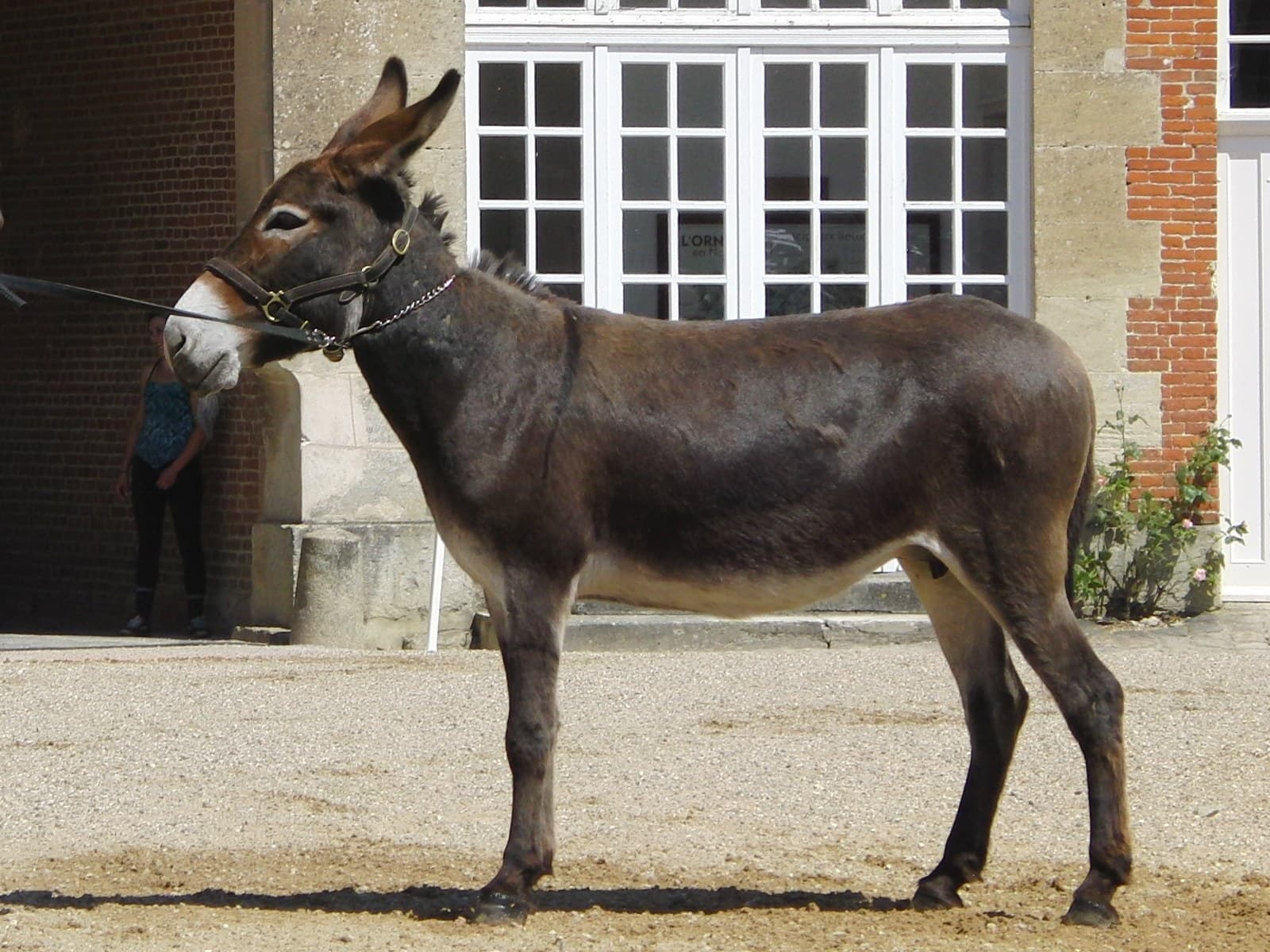
A Norman donkey presented at Haras du Pin.

The Norman donkey: an assistant on dairy farms
The Norman donkey: Milk transport shaped its working history
The Norman donkey breeding programme places the home region in Normandy’s five departments and in Mayenne and Sarthe. From the nineteenth century until mechanisation, donkeys carried milk churns between fields and farms. That work favoured small, compact, sturdy animals. The Association nationale de l’Âne normand now coordinates conservation and promotion of the population and its modern uses.
Sources for this section: Association nationale de l’âne normand [1]
The Norman donkey: a small, muscular donkey
The Norman donkey: 1.10–1.25 m at age three
Association nationale de l’âne normand describes the desired traits of the Norman donkey in its breeding programme. This document guides the choice of breeding animals. The Norman donkey breed standard gives the same height range for males and females: 1.10–1.25 m at three years. A limited tolerance applies to certain animals registered by descent with excellent type and conformation. A strong neck, firm back, broad loin and rounded hindquarters are accompanied by clean joints, short cannon bones (the long bones above the fetlocks) and broad hooves. The build should remain balanced and functional in movement.
Sources for this section: Association nationale de l’âne normand [1]
The Norman donkey: a brown coat with lighter points
The Norman donkey: the cross and pale muzzle are standard features
The French Norman donkey breed standard uses bay, chocolate and noir pangaré, with a dorsal stripe and shoulder stripe forming a visible cross. The belly, eye rings and lower muzzle are lighter. Leg barring may be present or absent. A donkey without the required light points falls outside the standard. These donkey colour descriptions should not automatically be translated into horse coat-colour genetics.
Sources for this section: Association nationale de l’âne normand [1] · UC Davis VGL [2]
The Norman donkey: Pack walking, driving and light work
The Norman donkey: New uses for a former farm assistant
Norman donkeys are promoted for pack walking, where loads are carried in suitable equipment, as well as driving and light work. Their size supports activities involving a range of users. Training, well-fitted equipment and an appropriate load remain necessary. Developing these uses gives animals from conservation breeding a practical future beyond simply retaining their registration.
Sources for this section: Association nationale de l’âne normand [1]
The Norman donkey: Studbook entry and breeding qualification
The Norman donkey: Different procedures for jacks and jennies
The studbook is the register that records the identity and ancestry of animals admitted to the breed. The responsible organisation is Association nationale de l’âne normand. Registration by descent depends on parents meeting the studbook requirements. Breeding males, or jacks, must be approved, and females, or jennies, confirmed. Initial admission is possible for certain conforming animals: females must be at least four and accompanied by a foal sired by a Norman jack. The commission checks conformation, documents and the specific requirements of each procedure.
Sources for this section: Association nationale de l’âne normand [1]
Registered Norman donkey births
The Norman donkey: 28 registrations in provisional 2022 data
The Norman donkey breeding programme reports 39 births in total in 2022, including 28 registered as Norman donkeys. These provisional figures distinguish births counted from breed registrations. To support breeding, a group of young males intended to become breeding jacks was established in 2021 with Normandy partners. Choosing males from different families broadens mating options and helps prevent births from being concentrated around just a few sires.
Sources for this section: Association nationale de l’âne normand [1]
The Norman donkey: Coat tests required for Norman jacks
The Norman donkey: Testing for red and no-light-points variants
Donkey-specific tests detect variants associated with red colour and the absence of pale areas around the muzzle, eyes and belly. Jack approval rules require candidates to carry neither the red nor the no-light-points variant. These are colour tests, not disease screens. Donkey variants are not interchangeable with those in horse panels, so the laboratory must use the appropriate donkey tests.
Sources for this section: Association nationale de l’âne normand [1] · UC Davis VGL [2]
Sources and review date
Profile reviewed on .
The documents below were used to prepare this profile of the Norman donkey. They explain which animals can enter the studbook and how breeding animals are selected.
- Association nationale de l’âne normand — Studbook rules and breeding programme, document distributed in 2024
Programme distributed by IFCE: standard, colour tests and provisional 2022 figures distinguishing 39 births from 28 Norman registrations.
- UC Davis VGL — Donkey coat-colour tests
Donkey-specific red and no-light-points tests, distinct from an equine inherited-disease panel.