
Breeds · breed profile
Cotentin donkey
The Cotentin donkey, a grey donkey with a dark cross
The Cotentin donkey is a Normandy breed with a dove-grey coat, a dark cross and pale points. Its history is closely tied to milk transport on farms in Manche. Recognised in 1997, it is now used for pack work, driving, leisure and other suitable working activities.
- Category
- Donkey
- Country of origin
- France
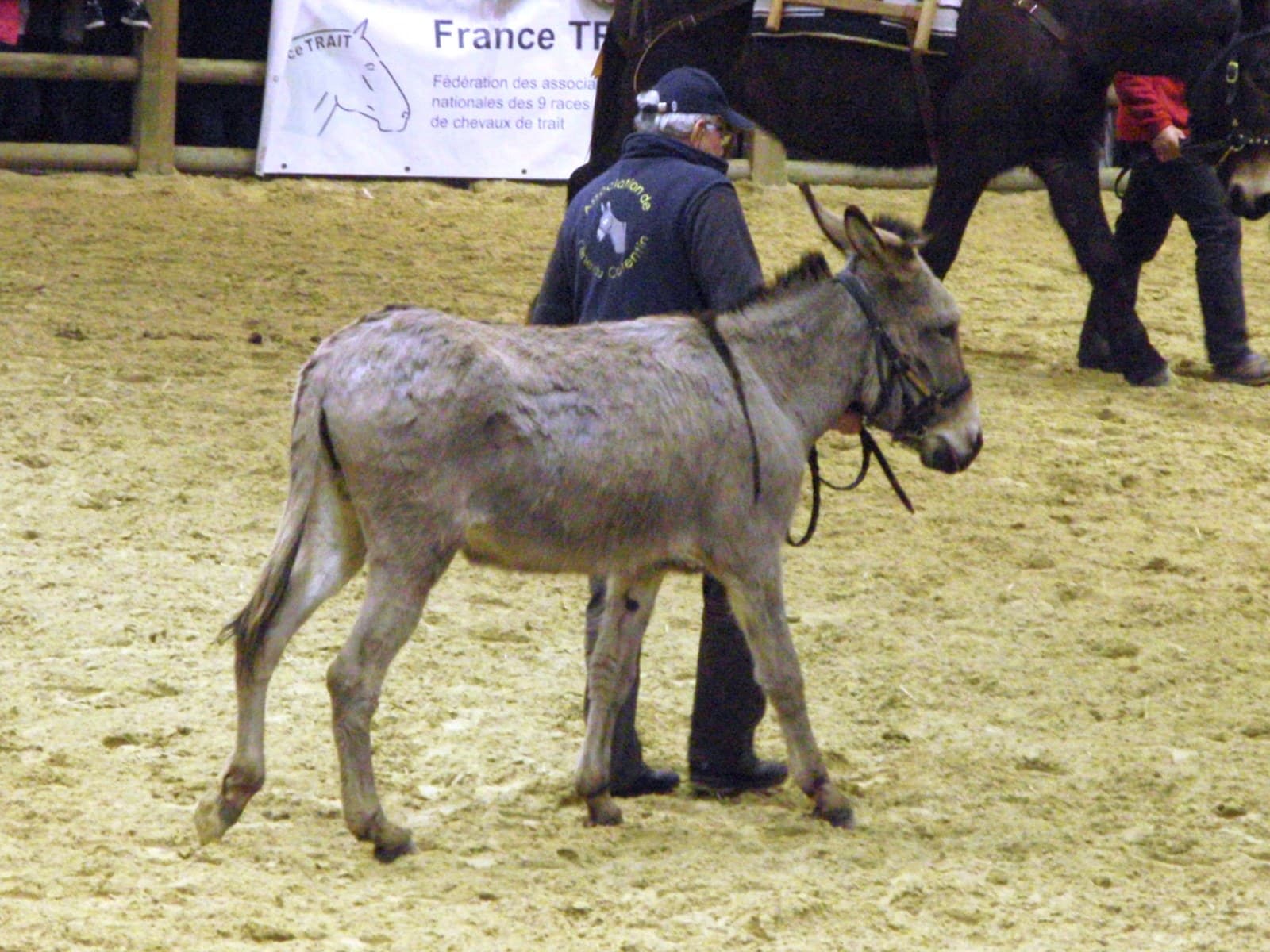
A Cotentin donkey shown in hand at the 2013 Paris agricultural show.

The Cotentin donkey: From milk transport to conservation
The Cotentin donkey: an association established in 1995
Dairy farming gave donkeys an important role in Cotentin, carrying churns and supporting travel and farm tasks. Motorisation subsequently reduced their numbers. Conservation became organised with an association in 1995, followed by breed recognition in 1997. The present studbook allows the population to be followed separately from Normandy’s other donkey breeds.
Sources for this section: Association de l’âne du Cotentin [1]
The Cotentin donkey: a sturdy donkey with sex-specific height ranges
The Cotentin donkey: Standard measurements at age three
Association de l’âne du Cotentin describes the desired traits of the Cotentin donkey in its breeding programme. This document guides the choice of breeding animals. The Cotentin donkey breed standard gives 1.20–1.35 m for males and 1.15–1.30 m for females at three years. Certain females of particular breeding interest may be accepted up to two centimetres above the upper limit. The back is straight, chest open and limbs strong. The head has a straight profile, ears are well opened and the mane stands upright.
Sources for this section: Association de l’âne du Cotentin [1]
The Cotentin donkey: the Cotentin’s dove-grey coat and cross
The Cotentin donkey: Donkey grey does not imply horse-style greying
The Cotentin donkey breed standard describes dove grey, sometimes with grey or blue shades, a dorsal stripe and a dark shoulder stripe. The belly, eye rings and lower face are pale grey-white. Leg barring may occur. This donkey colour is not, merely because it is called grey, the progressive greying familiar in horses. Animals lacking the required pale points are among those excluded by the standard.
Sources for this section: Association de l’âne du Cotentin [1] · USDA APHIS [2]
The Cotentin donkey: Pack work, driving and local services
The Cotentin donkey: Uses beyond recreational walking
The Cotentin donkey is used to carry walkers’ luggage in a pack saddle and to pull a small carriage. Its breeding programme also mentions market gardening, carrying small loads, maintaining grounds and supervised animal-assisted activities. Donkeys need to learn to accept the equipment and respond to their handler. These uses help breeders find homes and working roles for the foals they produce, while passing on the skills needed to work with donkeys.
Sources for this section: Association de l’âne du Cotentin [1]
The Cotentin donkey: Jack approval and jenny confirmation
The Cotentin donkey: Conformation and practical tests both contribute
The studbook is the register that records the identity and ancestry of animals admitted to the breed. The responsible organisation is Association de l’âne du Cotentin. The studbook distinguishes an animal’s registration from its permission to breed. Jack candidates must be at least three, with checked identity, a genetic profile and the required practical assessments. For males approved after January 2010, an initial five-year period precedes reassessment for permanent approval. Jennies require confirmation, and initial-entry routes also exist under the studbook conditions.
Sources for this section: Association de l’âne du Cotentin [1]
Replacement breeding in the Cotentin donkey
The Cotentin donkey: 68 registered offspring in 2022
The programme records 68 offspring registered as Cotentin donkeys in 2022, with 95 jennies covered to produce the breed and 29 active males. These describe that year’s breeding activity, not all living animals. Manche and Normandy remain central, alongside breeders elsewhere. Passing small breeding operations to new keepers and maintaining reproduction are important conservation issues.
Sources for this section: Association de l’âne du Cotentin [1]
The Cotentin donkey: What genetic identification contributes
The Cotentin donkey: Reliable pedigrees and several family lines
For a Cotentin donkey breeding animal, the required “genotype” is a profile of DNA markers used for identification. By comparing these markers with a foal’s, a laboratory can check whether the animal is compatible with the declared parentage. This helps trace families in the studbook. Breeders can then identify close relatives and maintain several family lines when planning matings. This identification profile is not a screen for inherited diseases.
Sources for this section: Association de l’âne du Cotentin [1] · USDA APHIS [2]
Sources and review date
Profile reviewed on .
The documents below were used to prepare this profile of the Cotentin donkey. They explain which animals can enter the studbook and how breeding animals are selected.
- Association de l’âne du Cotentin — Studbook rules and breeding programme, document distributed in 2024
Programme distributed by IFCE: history, standard, approval and 68 registered births in 2022.
- USDA APHIS — Equine identification
Identification guidance, including the distinction between donkey grey and progressive greying in horses.