
Breeds · breed profile
Provence donkey
The Provence donkey, a pack animal that accompanied migrating flocks
The Provence donkey accompanied flocks between lowland Provence and mountain pastures, carrying shepherds’ supplies and equipment. These seasonal movements are known as transhumance. Breeders seek to preserve a strongly built donkey with a dove-grey coat. Its studbook records animals and their parents so the breed’s families can be traced.
- Category
- Donkey
- Country of origin
- France
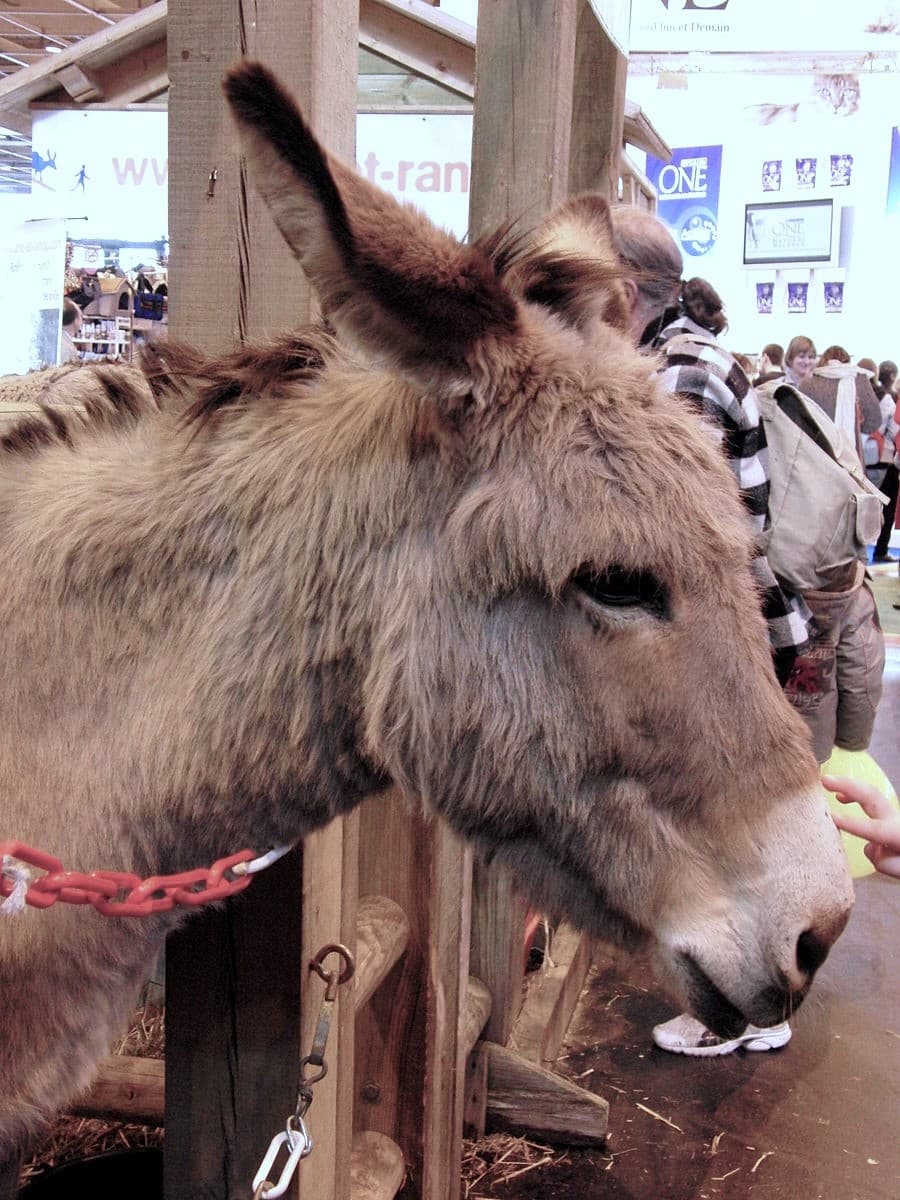
A Provence donkey at the 2010 Paris Agricultural Show.

The Provence donkey: Accompanying flocks on transhumance
The Provence donkey breeding programme traces this role to the fifteenth century, along routes between Provence, the Alps and the Cévennes. Donkeys carried salt, provisions and shepherds' equipment, sometimes young lambs. Transhumance means moving livestock between seasonal grazing grounds. The studbook, established in 1995, provided a framework for preserving this regional type.
Sources for this section: Association de l’âne de Provence [1]
The Provence donkey: Different height ranges for males and females
Association de l’âne de Provence describes the desired traits of the Provence donkey in its breeding programme. This document guides the choice of breeding animals. At three years the standard provides 1.20–1.35 m for males and 1.17–1.30 m for females, with some tolerance for strongly typical animals. The head is substantial with a straight profile, the neck medium in length and the back supported. A short loin, rounded croup, solid limbs and well-formed feet complete the build, which is assessed alongside movement.
Sources for this section: Association de l’âne de Provence [1]
The Provence donkey: Dove-grey colouring and dark markings
The desired coat is evenly dove-grey, with dark dorsal and shoulder stripes forming a cross. The underside, muzzle and eye surrounds are lighter; leg barring is valued. Here, “grey” describes the donkey's appearance. It does not by itself establish the same progressive greying mechanism found in horses.
Sources for this section: Association de l’âne de Provence [1]
The Provence donkey: Packing, walking and driving
Packing remains closely connected to the breed's history, allowing equipment to be carried on accompanied walks. Driving and some agricultural activities provide further uses. Training introduces harness, loads and the situations encountered along a route. Practical ability is assessed in a prepared animal with appropriately fitted equipment and a suitable load.
Sources for this section: Association de l’âne de Provence [1]
The Provence donkey: the breed association's programme
The Association de l'âne de Provence runs the selection programme published by IFCE. The studbook preserves identities and ancestry; its rules define admission and breeding qualification. A grey donkey living in Provence does not automatically belong to the breed. Documents, physical type and registration conditions must be considered together.
Sources for this section: Association de l’âne de Provence [1]
The Provence donkey: French production in 2021
The Provence donkey breeding programme written in December 2022 reports 21 births in France for 2021. Its breeding indicators separately list 46 jennies covered and 26 active jacks. These numbers represent different stages of breeding rather than a census of living animals. South-eastern France remains the breed's home, although breeders also keep it elsewhere in France and abroad.
Sources for this section: Association de l’âne de Provence [1]
The Provence donkey: Conservation needs several families
Pedigrees help identify shared ancestors and distribute the use of breeding males. Conserving a small breed involves more than increasing foal numbers: less-represented families also need to persist. A dorsal cross or coat shade cannot measure that diversity. Mating decisions therefore draw on recorded origins as well as the qualities of individual donkeys.
Sources for this section: Association de l’âne de Provence [1]
Sources and review date
Profile reviewed on .
The documents below were used to prepare this profile of the Provence donkey. They explain which animals can enter the studbook and how breeding animals are selected.
- Âne de Provence — Programme de sélection, décembre 2022
Studbook document covering selection, registration, breeding assessments and dated figures where available.