
Breeds · breed profile
Corsican donkey
The Corsican donkey, an island population with a recent studbook
The Corsican donkey is associated with transport and farm work in Corsica. Its studbook, established in 2020, organises recognition and conservation of a local type. It is separate from the Corsican horse, which belongs to another species and another studbook.
- Category
- Donkey
- Country of origin
- France
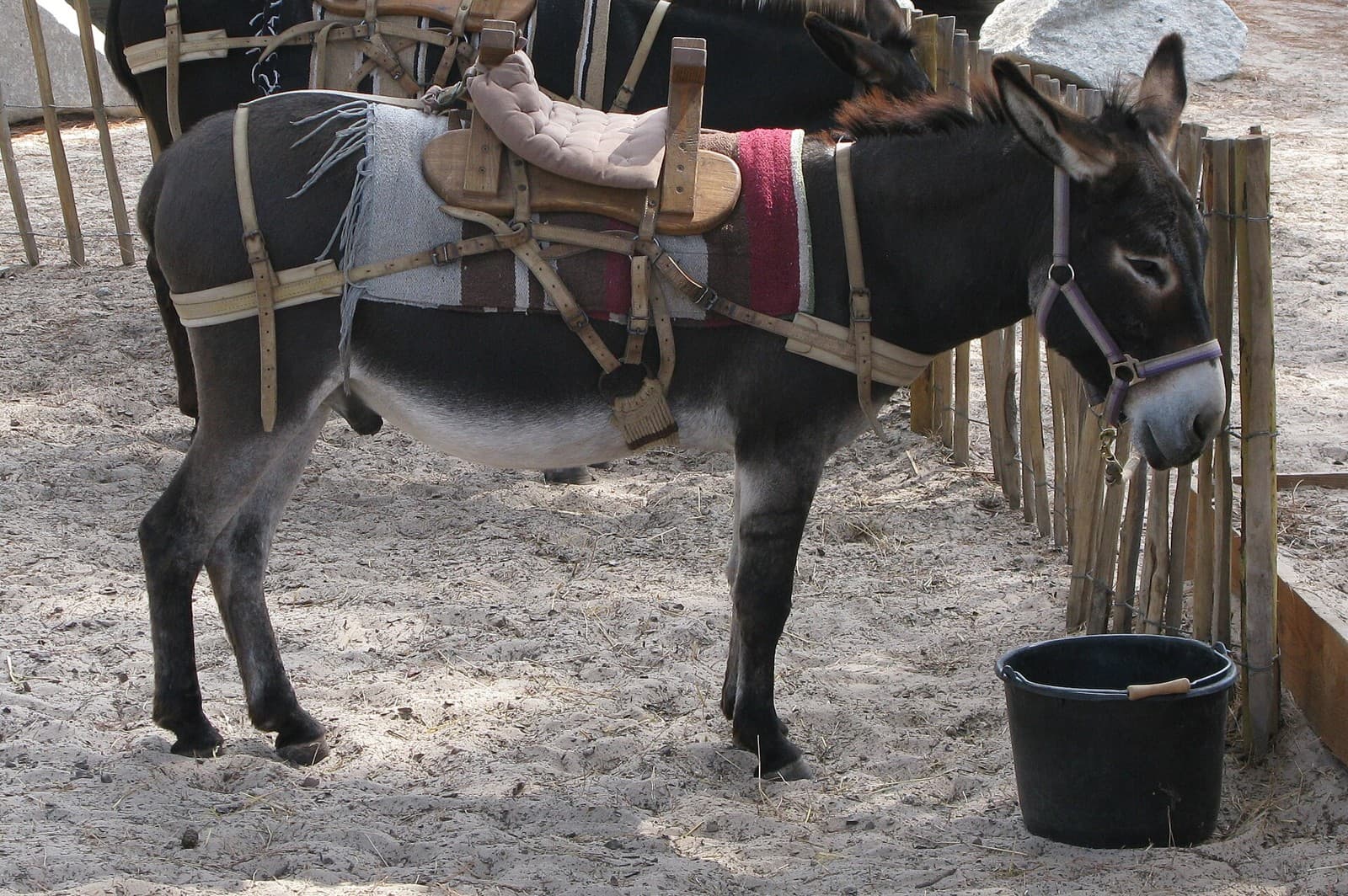
A Corsican donkey carrying a pack saddle in Calvi's pine woods in 2014, before the studbook was established.

The Corsican donkey: From everyday work to conservation
Donkeys long carried people, crops and equipment along Corsican paths. Motorised transport reduced their economic role and numbers. The October 2024 programme describes that decline and the establishment of the studbook in 2020. The current project identifies animals matching the local type and builds a documented breeding population.
Sources for this section: U Sumeru Corsu [1]
The Corsican donkey: a small donkey measured according to age
U Sumeru Corsu describes the desired traits of the Corsican donkey in its breeding programme. This document guides the choice of breeding animals. From four years, the standard provides 1.15–1.28 m for females and 1.15–1.29 m for males, with a 2 cm tolerance. Separate ranges apply at three years. The head is light with a straight or slightly concave profile, the ears point forward, the back is compact and the croup rounded and muscular. Limbs and feet should support a regular walk.
Sources for this section: U Sumeru Corsu [1]
The Corsican donkey: Several colours within a defined standard
The Corsican donkey breeding programme describes dove-grey, chocolate and dark black or bay coats with lighter areas. A dorsal cross is sought and leg barring is valued. Other appearances, including pinto, white, cream and chestnut, fall outside the stated criteria. An acceptable colour contributes to assessment but does not establish ancestry on its own.
Sources for this section: U Sumeru Corsu [1]
The Corsican donkey: Packing and local activities
Accompanied walks, pack work and some agricultural or animal-assisted activities can provide outlets for conserved animals. A pack saddle should distribute weight without restricting movement. Gradual preparation for equipment, people and different terrain is needed even when the activity resembles the island donkeys' historical work.
Sources for this section: U Sumeru Corsu [1]
The Corsican donkey studbook since 2020
The U Sumeru Corsu association runs the programme. With a recent studbook, inspection of foundation animals and recording of parentage are particularly important. Rules distinguish initial admission, registration of descendants and breeding approval. An animal's presence on Corsica, or an old photograph, does not by itself prove registration in this studbook.
Sources for this section: U Sumeru Corsu [1]
The Corsican donkey: Declared breeding activity in 2024
The 2025 Écus yearbook records ten jennies covered in 2024 for anticipated Corsican donkey production, in provisional data dated 21 October 2025. This small administrative total is not the number of all donkeys on the island. The wider local population includes animals whose ancestry or registry status differs from that of the studbook's tracked breeding stock.
Sources for this section: IFCE — Écus 2025 [2]
The Corsican donkey: DNA profiles support developing pedigrees
The Corsican donkey breeding programme requires a DNA profile for jacks presented for breeding approval from three years of age. The laboratory analyses selected DNA markers, which can later be compared with a foal’s markers to check the declared parentage. Combining these checks with birth records allows the studbook to trace families across generations. This test checks family relationships; it does not look for disease-causing variants.
Sources for this section: U Sumeru Corsu [1]
Sources and review date
Profile reviewed on .
The documents below were used to prepare this profile of the Corsican donkey. They explain which animals can enter the studbook and how breeding animals are selected.
- Âne corse — Programme de sélection, octobre 2024
Studbook document covering selection, registration, breeding assessments and dated figures where available.
- IFCE — Annuaire Écus 2025
IFCE-SIRE statistics: French breeding activity in 2024, provisional at 21 October 2025, p. 11.