
Breeds · breed profile
Bourbonnais donkey
The Bourbonnais donkey, a working donkey of central France’s small farms
The Bourbonnais donkey comes from central France, where it served small farms and local transport. Bay to chocolate colouring, a dorsal cross and pale areas around the muzzle contribute to its appearance. Conservation now relies on a studbook and the maintenance of several breeding families.
- Category
- Donkey
- Country of origin
- France
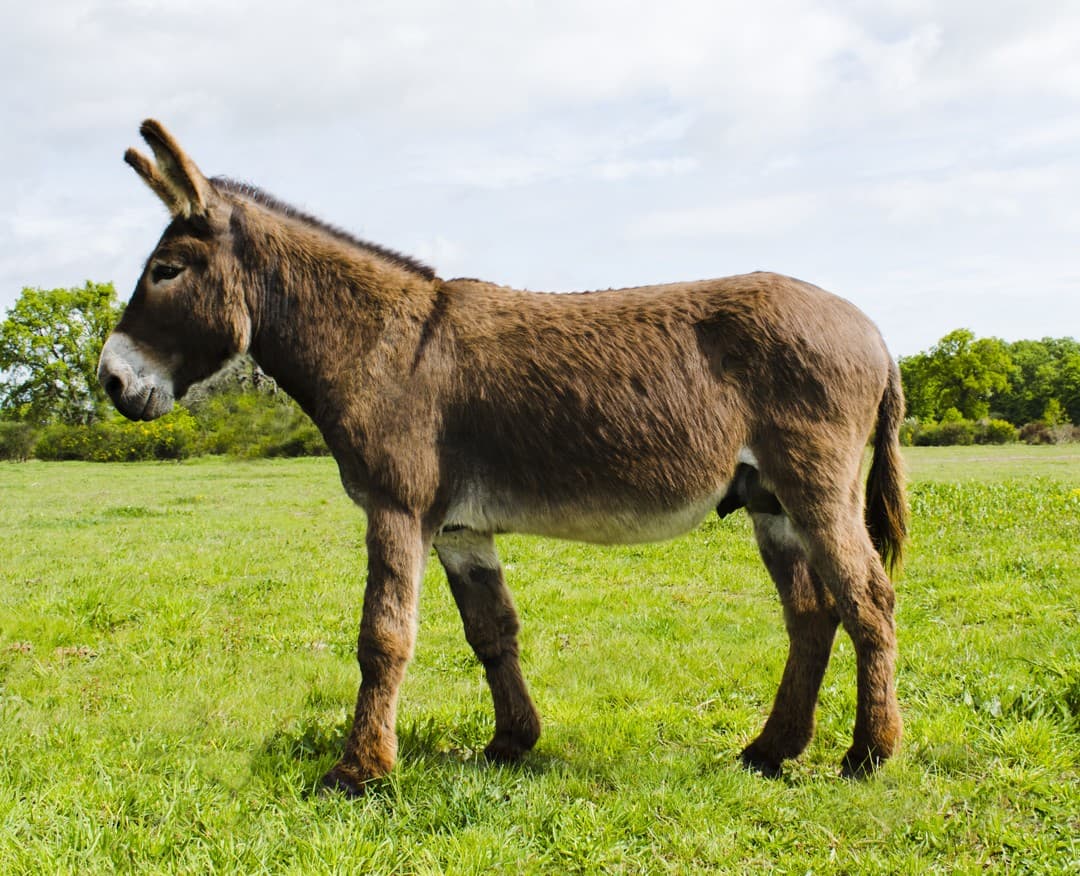
Shalom, a Bourbonnais donkey, shown in profile at pasture.

The Bourbonnais donkey: Working on farms and travelling to market
Bourbonnais donkeys worked in Allier and neighbouring areas, including Boischaut, northern Puy-de-Dôme and southern Nièvre. They undertook light farm work, carried hay and travelled to local markets. Driving associated with tourism in Vichy was another use. Mechanisation reduced these roles, and creation of the studbook in 2002 supported efforts to conserve the breed.
Sources for this section: AFAB [1]
The Bourbonnais donkey: a solid build between 1.20 and 1.35 m
Association française de l’âne bourbonnais (AFAB) describes the desired traits of the Bourbonnais donkey in its breeding programme. This document guides the choice of breeding animals. The Bourbonnais donkey breed standard seeks 1.20–1.35 m at three years for both sexes, with some tolerance for strongly typical animals. The head carries long ears; the back should be straight and muscular, and the croup rounded and sloping. Short cannons, sound joints and correctly aligned feet support the body. Overall balance should allow the donkey to walk and work freely.
Sources for this section: AFAB [1]
The Bourbonnais donkey: Bay to chocolate with a dark cross
The Bourbonnais donkey breed standard describes bay to chocolate coats, a dark stripe along the spine and a shoulder stripe that together form a cross. The underside, eye surrounds and muzzle are paler. These features help describe the Bourbonnais type, but they also occur in other donkeys and do not replace documented registration.
Sources for this section: AFAB [1]
The Bourbonnais donkey: Walking, packing and light driving
Current activities continue its role as a close working companion: accompanied walks, carrying equipment with a pack saddle and light driving. A pack saddle distributes loads on either side of the back. Training, careful fitting and a suitable load connect historical use with practical work by a prepared animal.
Sources for this section: AFAB [1]
The Bourbonnais donkey: the studbook run by AFAB
The Association française de l'âne bourbonnais (AFAB) organises conservation and the selection programme. Identity, ancestry and conformity to the standard contribute to the different registration routes. Approval of a jack, the term for a male breeding donkey, is separate from basic identification. Following bloodlines helps plan the next generation of breeding animals.
Sources for this section: AFAB [1]
The Bourbonnais donkey: Recorded births in 2022
The Bourbonnais donkey breeding programme reports 14 births in France for 2022, alongside eight active jacks and 28 active jennies in the corresponding breeding table. Births and breeding animals are different categories; adding them would not give the living population. These small figures make the retention of several families particularly relevant.
Sources for this section: AFAB [1]
The Bourbonnais donkey: Pedigrees help distribute breeding opportunities
Records of parents and ancestors help avoid concentrating offspring around a few related males. When DNA parentage is checked, markers test compatibility with the declared parents. This supports pedigree accuracy but does not measure all the donkey's functional qualities. Conservation therefore combines family records with assessment of the animal itself.
Sources for this section: AFAB [1]
Sources and review date
Profile reviewed on .
The documents below were used to prepare this profile of the Bourbonnais donkey. They explain which animals can enter the studbook and how breeding animals are selected.
- Âne bourbonnais — Programme de sélection 2025
Studbook document covering selection, registration, breeding assessments and dated figures where available.